


Most sourcing problems do not start on the production line. They start the moment a buyer wires a deposit to a company that described itself as a factory but has no equipment, no production line and no control over the delivery schedule.
This guide is written by the Lingyi Supply Chain team. We have run warehouses and local teams in Yiwu, Shenzhen and Shantou since 2020, and supplier verification is part of the work we do before an order is placed, not a topic we researched from a desk. Lingyi Supply Chain operates through two registered Chinese legal entities, and our standard due-diligence package covers eight types of verifiable documents — from business licences and registration records to pre-shipment inspection photos — with zero findings across all 17 legal-risk indicators checked for both entities. We wrote this because the question we hear most often from importers contacting us for the first time is a simple one: “Is this supplier a real factory?”
Below is the sequence we actually use, why each step exists, and the warning signs that tend to appear before any money changes hands. It is written for SMEs and Amazon FBA sellers who cannot afford to fly to China for every order, but still need a defensible answer before paying a deposit.
Why “factory or trading company” actually matters
A trading company is not automatically a bad supplier. Some are well organised, hold useful certifications, and can coordinate several factories for a mixed-product order far better than a single workshop could. The problem is an undisclosed middleman — a seller who presents someone else’s production capacity as its own. That gap shows up in five places:
- Price. There is a margin between the factory gate price and what you are quoted, and you cannot tell how large it is.
- Customisation. A trading company has to relay your specification to a factory it does not control. Each relay loses detail, and mould or tooling ownership becomes unclear.
- Lead time. Without a direct line to the production schedule, “15 days” is an estimate, not a commitment.
- Accountability. When a defect appears, the seller and the workshop can each point at the other.
- Payment risk. The strongest fraud signal we see is a bank account whose name does not match the company on the business licence.
In other words, the goal is not “only buy from factories”. The goal is know exactly who you are contracting with, and paying the entity that is legally and operationally responsible for the goods.
| Question | Real factory | Trading company / agent |
|---|---|---|
| Business scope on licence | Includes manufacturing / production (生产、制造) | Usually sales, wholesale, import-export only (销售、贸易) |
| Physical address | Industrial zone, workshop, loading bay | Office building, shared workspace, or a market booth |
| Quotation behaviour | Asks about materials, tolerances, tooling, packaging spec | Answers quickly on price, slower on technical detail |
| Factory walkthrough | Can show live lines, in-process goods, raw material storage | Offers a showroom, a photo album, or a “factory we work with” |
| Bank account name | Matches the licence entity | Often a different company or a personal account |
The 7-step verification checklist
Step 1 — Check the business licence, and read the scope line
Ask for a scan of the business licence (营业执照) and the 18-character Unified Social Credit Code. Any legitimate Chinese company will have one, and refusing this request is itself an answer.
Then verify it against the official National Enterprise Credit Information Publicity System (gsxt.gov.cn), which is free and state-run. Check four things: the registered Chinese name matches the English name the supplier uses; the entity is still active; the registered address matches the address they gave you; and — most importantly — the business scope (经营范围) includes production or manufacturing, not only sales and trading. A company whose scope is “sales of daily necessities” cannot legally be the manufacturer of those goods.
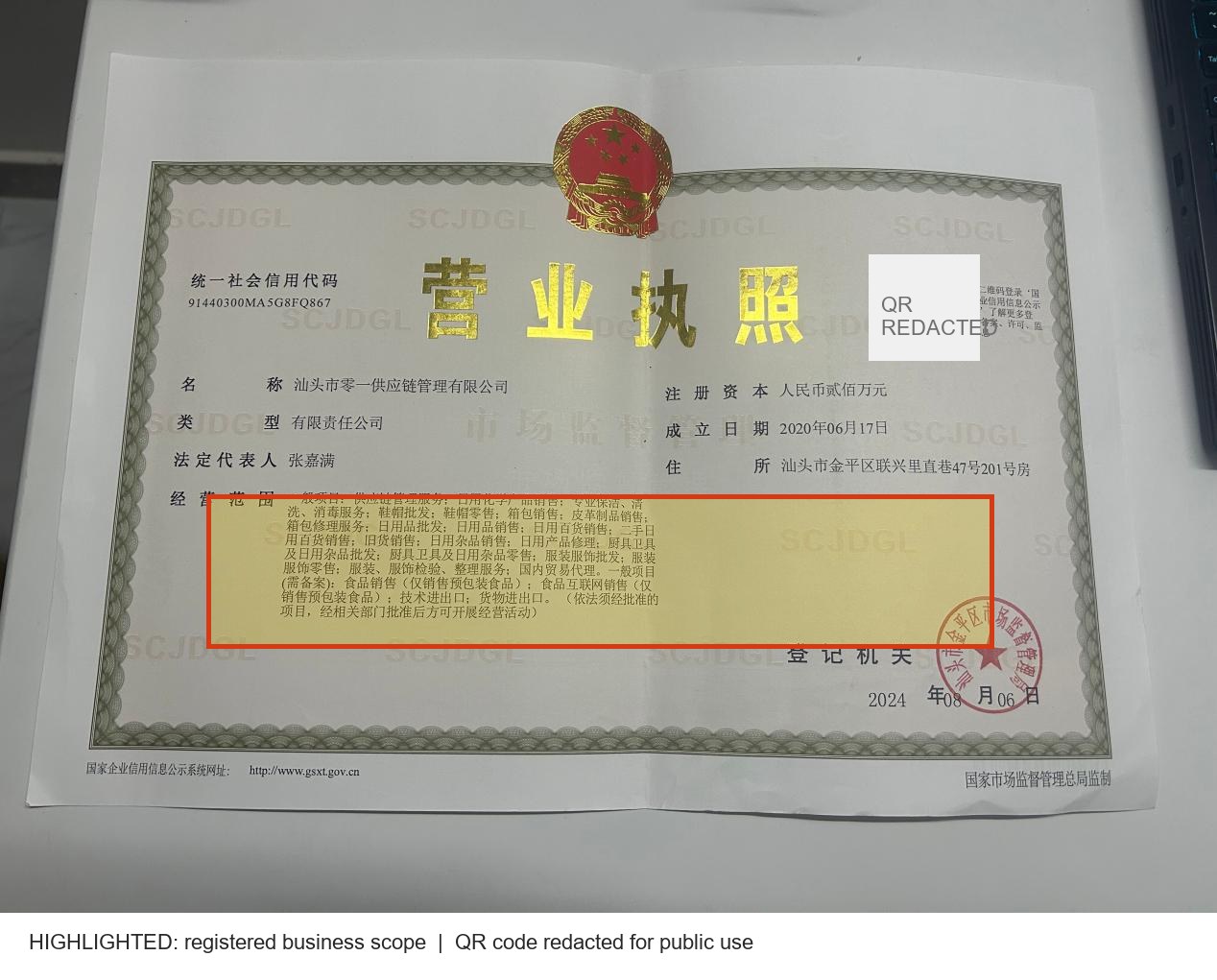
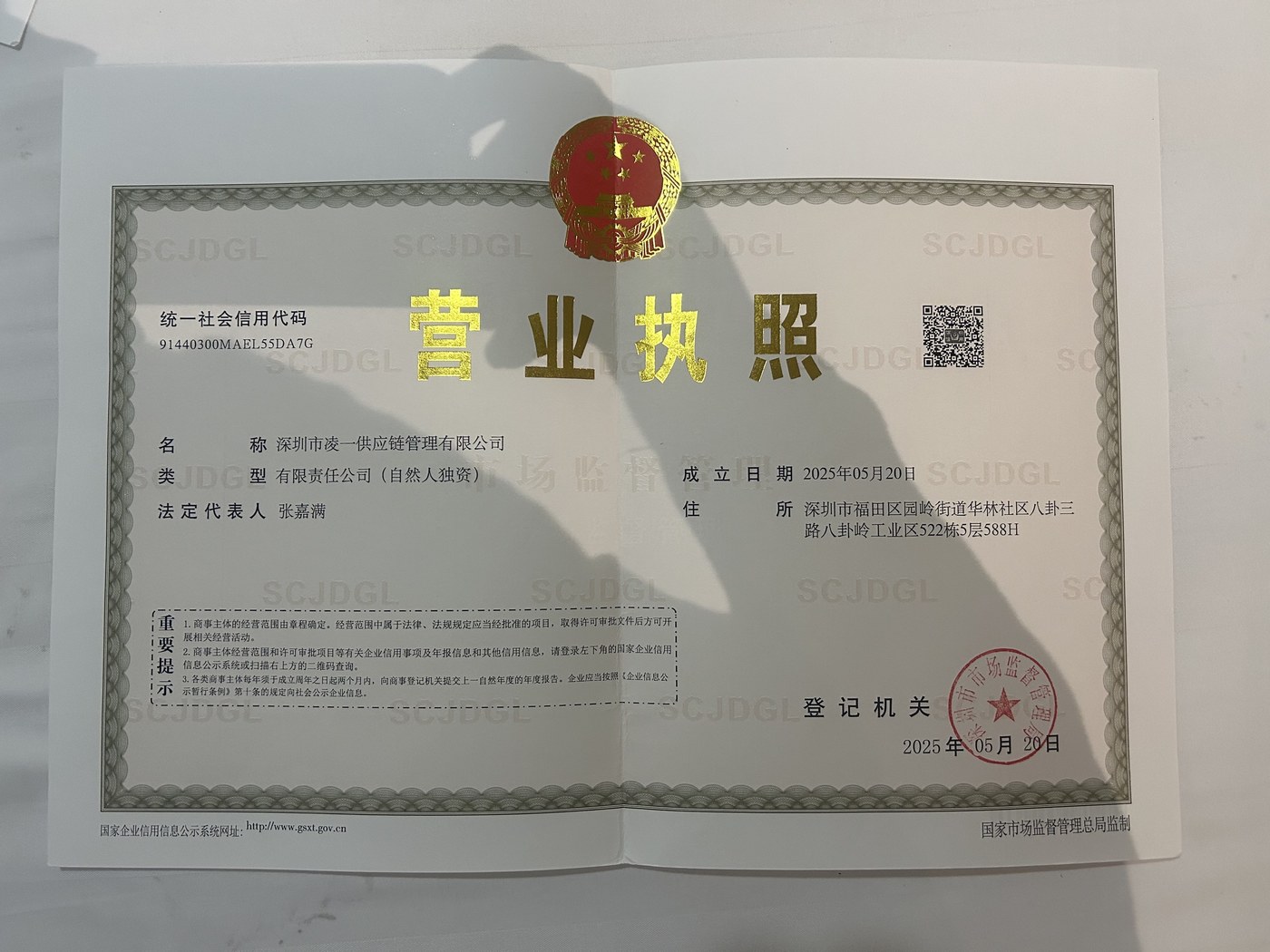
Also note the founding date and registered capital. Neither proves capacity, but a company registered eleven months ago claiming ten years of export experience is worth a follow-up question. The same test applies to us. Our Shantou entity’s licence explicitly lists supply chain management, garment inspection and sorting, and import/export in its business scope — verifiable on the licence, not just claimed on a website. Our Shenzhen entity is a separate registered company, which is why contracts, invoices and export documents may be issued under either name.
Step 2 — Match the address to a real production site
Put the registered address into a map service and look at what is there. Industrial parks, warehouse clusters and factory buildings are a good sign. A serviced office in a downtown tower, a residential compound, or a unit inside a wholesale market is not a production site.
Ask for a live video walkthrough, not an edited clip. Give the sequence on the call: start at the gate with the company sign, walk through raw material storage, then the production line, then the packing area, then finished-goods storage. Ask to see goods currently in process for another order. A real workshop can do this in five minutes; a middleman will usually negotiate the scope of the tour, offer a showroom, or send a pre-recorded file. Because our team is based in Yiwu, Shenzhen and Shantou, we can also visit in person, and we send back the visit notes, the photos and the checklist we used before you release the balance payment.
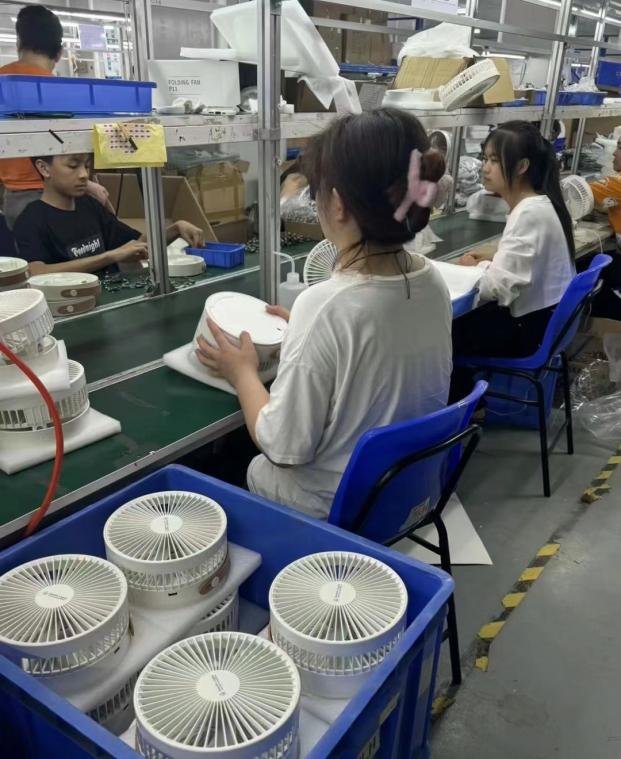
What we share before an order is placed. Our verification pack is assembled per order rather than as a generic template, and we can send it over before you commit: the business licence, company registration information, bank information, a commercial invoice sample, a packing list sample, shipping documents, factory photos from the production stage, and pre-shipment quality inspection photos. On request we also coordinate with the factory for production photos or live video. The images in this article come from real inspections — vehicle plates and shipping labels are masked before we publish them.
Step 3 — Ask for production evidence, not marketing photos
Catalogue photography proves nothing about who owns the machines. Ask instead for evidence that is hard to stage:
- an equipment list with the number of lines, machines and shifts, and a stated daily capacity for your product type;
- utility bills or raw material purchase records from the last three months, with commercial details redacted;
- photos or short clips of your product category actually running on the line, not just finished samples on a table;
- clarity on who owns the mould or tooling, and whether it can be released if you change supplier.
Consistency is the test. The stated capacity, the number of lines, the address and the licence scope should all describe the same operation. When they do not, you are probably talking to someone who is describing a partner factory.
Step 4 — Validate certificates properly, including the entity name
Certificates are the most commonly misrepresented document in sourcing. For each certificate, check the certificate number, issuing body, validity dates, and — critically — the company name and factory address on it. We regularly see ISO 9001 or BSCI documents that belong to a different legal entity, or product test reports covering a different model than the one being quoted.
Match documents to your market and category: ISO 9001 or BSCI / Sedex for social compliance; CE, FCC, UKCA, EN 71, FDA or LFGB depending on product and destination; and factory audit approvals such as Disney FAMA where brand licensing applies. Ask for the original PDF, not a screenshot, and verify the number with the issuer or certification body’s database where one exists. A test report issued to a trading company does not certify the factory that will make your goods.
Step 5 — Use the sample stage as an audit
Samples are usually treated as a quality check, but they are also a verification opportunity. Pay the sample fee to the company bank account named on the licence, not to a personal account or a third party. Ask who will produce the sample and whether it comes from the same line as mass production. Note the sample reference number, and ask for it to be recorded against the production order later — a sample made by hand in a sample room and a production run made on a different line is a classic source of “the bulk order does not match the sample” disputes.
If your product needs structural design, mould work or custom packaging, this is also where a real factory separates itself from a reseller: it can discuss tooling, tolerances and material substitutions in concrete terms. Our product development and prototyping service and private label and custom packaging work both start from this kind of technical conversation.
Step 6 — Ask for evidence of export history
You are not entitled to a supplier’s customer list, and asking for one is a red flag of its own. But a factory that exports regularly can usually show redacted bills of lading, customs declarations, or packing lists proving it has shipped to your region before, plus familiarity with your market’s labelling and documentation requirements. A supplier with no export records may still be excellent — but then someone else in the chain will be handling export, and you should know who.
This step also tells you whether the supplier is used to the compliance burden of your destination: Amazon FBA labelling, carton requirements, or destination-specific testing. If the answer is vague, plan for more hands-on preparation before shipment.
Step 7 — Audit before the balance payment, not after
Verification is not a one-time event at the quotation stage. Build the payment schedule around a check you control: a deposit to start production, then the balance only after an on-site inspection with a defined AQL standard (AQL 2.5 for major defects is a common starting point for consumer goods) and an approved pre-shipment sample. Our China product sourcing service includes production follow-up and quality control at this stage, and the same check applies whether the goods come from a single factory or are consolidated from several suppliers.
Here is what that looks like in practice — the five checks we actually run on an order, not a generic template:
- Sample confirmation. Approve a signed sample before production starts, not after.
- In-production follow-up. On request we coordinate with the factory for production photos or video, so you see the line, not a stock image.
- Pre-shipment inspection. Units are opened and checked; defects are logged and the quantity is confirmed against the order.
- Packaging and transit-risk check. Outer cartons are inspected; where damage or transit risk is found, reinforcement is applied before dispatch.
- Container and document check. The container is confirmed clean before loading, and the invoice, packing list and shipping address are checked against the buyer’s details before documents are issued.
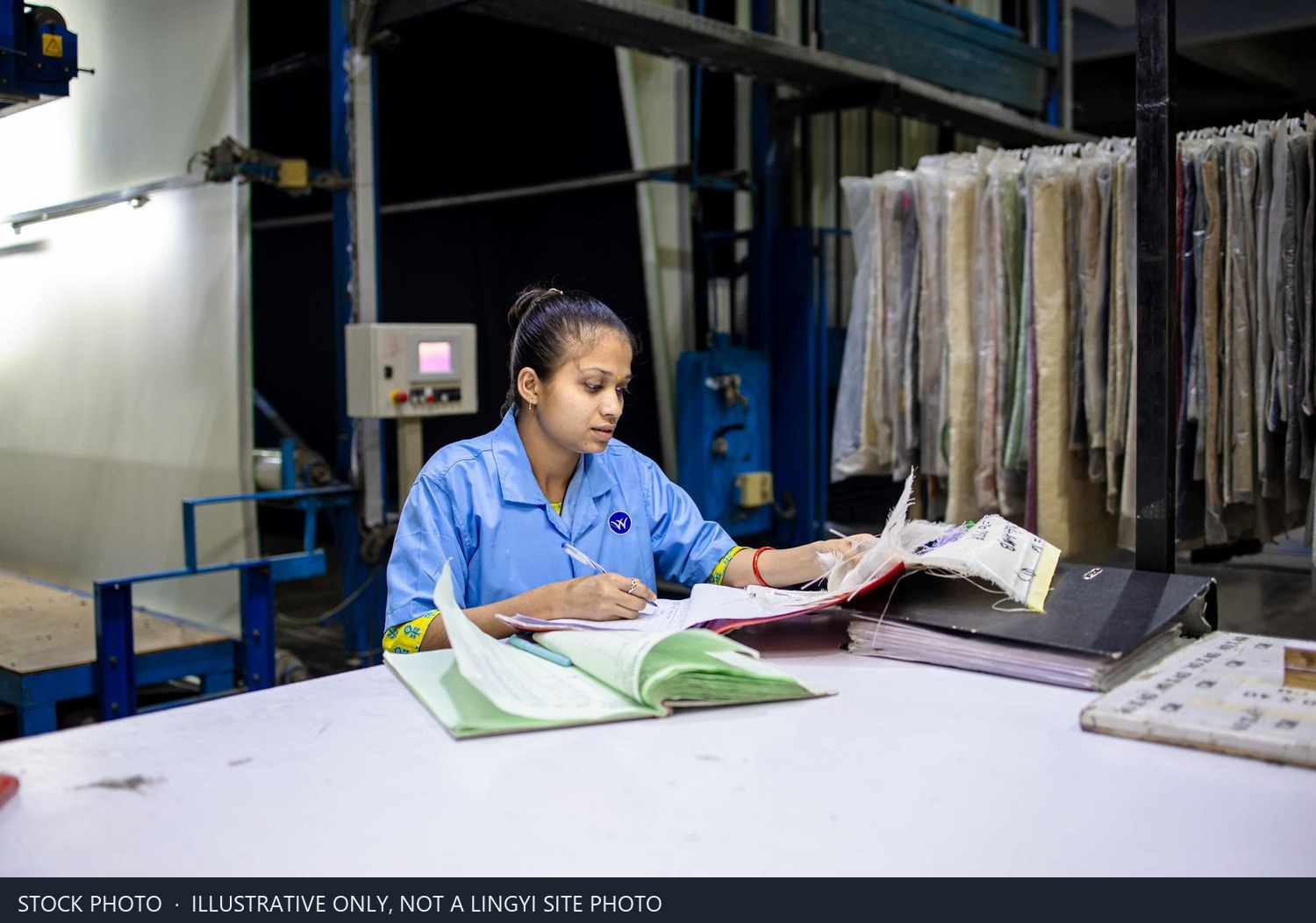
The photo below is a licensed stock image used for illustration only — it is not a photograph of our team or one of our inspections. The on-site photos and the office photo further down this guide are from real inspections and our own premises. Identifying marks are masked before we publish them.
Red flags we treat as stop signs
- The bank account name differs from the licence entity, or payment is requested to a personal account.
- The supplier refuses a live walkthrough but sends polished factory photos.
- The quotation arrives unusually fast with no questions about specification, quantity or packaging.
- The business scope contains only “sales” / “trading”, yet the company insists it manufactures.
- Certificates name a different company or a different address.
- The price is far below every comparable quote with no explanation of material or process differences.
- Communication moves to a personal chat account and the company email domain stops being used.
- Pressure to pay the full amount before production starts, or a deadline that expires “today”.
One or two of these can have an innocent explanation. Three or more usually mean the entity you are talking to is not the entity that will make your goods.
How we run this for clients
For buyers using our sourcing service, verification is folded into the standard process: shortlist suppliers across the Yiwu, Shenzhen and Shantou supply belts, check licences and certificates, confirm the site, compare quotations on the same specification, manage sampling, then inspect before shipment. When a client needs surplus or cancelled-order stock rather than a production run, we apply the same entity checks in our overstock sourcing work — the risk of an undisclosed middleman is actually higher there.
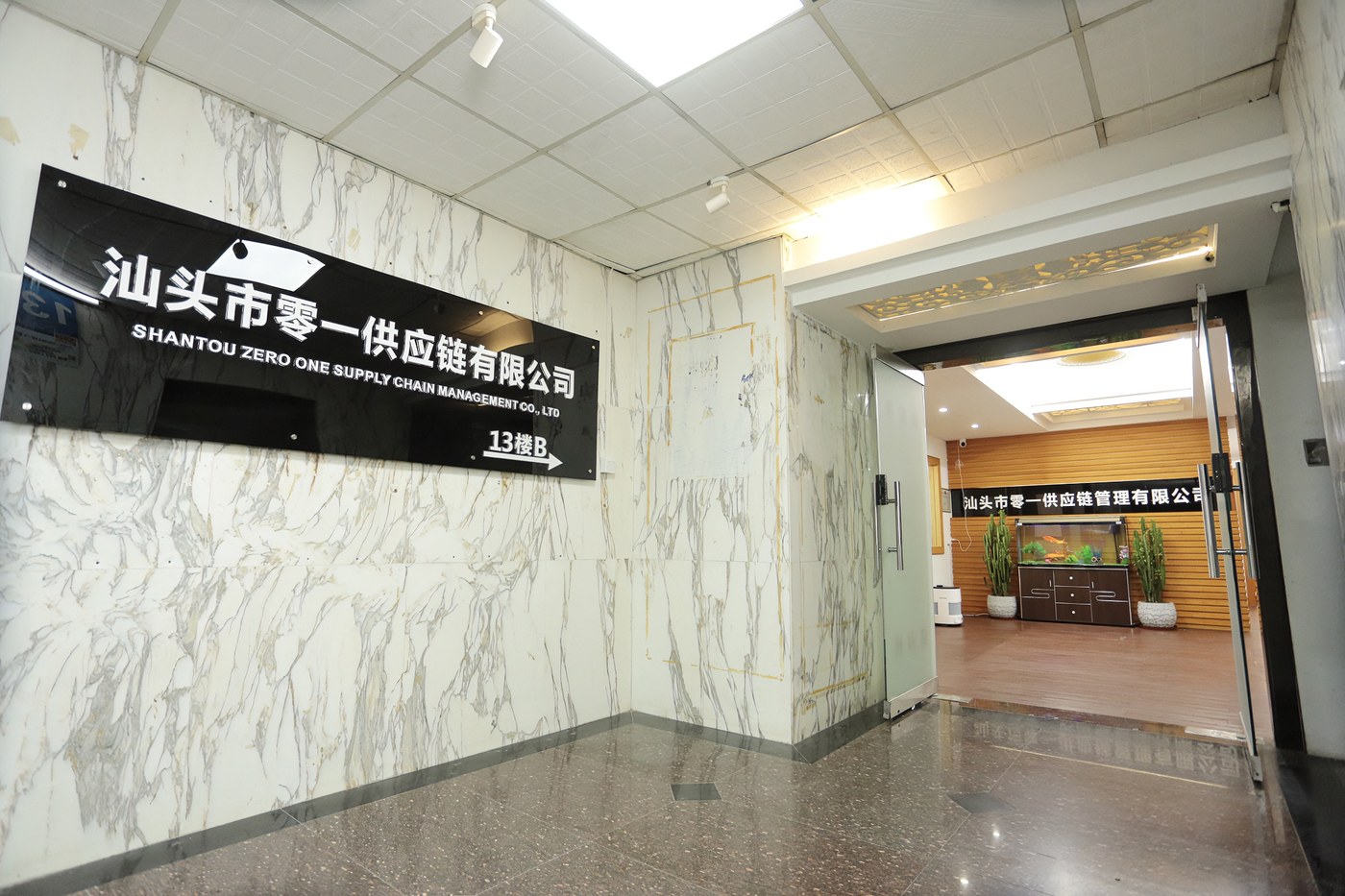
You can also come and see us. We work from three locations in China, all open to in-person visits or a live video call: our Shantou office at B2, 13/F, Building A, Jinlong Building, Shantou, Guangdong; our Shenzhen office at Room 302, 3/F, Complex Building, Longcheng Industrial Park, Dalang Subdistrict, Longhua District, Shenzhen, Guangdong; and our Yiwu desk at Rooms 218–220, 2/F, Area A, Yiwu Port, Yiwu, Jinhua, Zhejiang 322000. One detail worth remembering when you check any Chinese supplier: the registered address on the licence and the office where the team actually works are often different. Always ask which one you are being shown.
Three short examples from real order threads, with client names, phone numbers, order numbers, amounts and delivery addresses removed. We have kept the detail of what actually happened rather than inventing a more dramatic story:
Case 1 — dimensions and quantity re-checked before the balance payment. A Brazilian importer asked us to re-confirm product dimensions and the exact quantity before releasing the balance payment. Rather than replying with a generic assurance, our team checked the batch on site, sent the dimension notes and quantity confirmation, and waited for the buyer to confirm both were correct before the shipment moved forward. The buyer’s reply was short: apparently everything was fine, and the quantity was fine too.
Case 2 — an invoice query and a container check in the same thread. When a buyer flagged a possible overcharge on one invoice line, we pulled the calculation and went back to the buyer after checking, instead of issuing a stock apology. In the same thread we sent container photos with a note confirming the container had been checked again and was clean before loading. Amounts and the order number are withheld here.
Case 3 — pickup and payment release confirmed without being asked. After the goods were collected, the buyer came back unprompted to say the pickup had gone smoothly, and later confirmed the order was complete, the goods had arrived, and the payment release had already been made. Two separate confirmations, in the same chat thread, without us asking for a review.
We do not publish the chat screenshots themselves: they contain phone numbers, order numbers, amounts and delivery addresses, and a client conversation is not ours to make public.
Frequently asked questions
Is buying through a trading company always a mistake?
No. For a mixed-category order spanning several factories, a competent agent can save you a great deal of coordination work. The mistake is paying a factory price to a company that never disclosed it is an agent, or not knowing which entity is liable if the goods fail inspection. Ask directly, and get the answer in writing.
Is a valid business licence enough on its own?
No. A licence proves a legal entity exists; it does not prove that entity owns a production line, has the capacity it claims, or will be the one making your order. Treat it as step one, not the conclusion.
Can I verify a factory without travelling to China?
Much of it, yes: licence checks, document validation, a live video walkthrough, sample-stage questions and a third-party pre-shipment inspection cover most of the risk. A physical audit still adds the most information, which is why having a local team in the three sourcing regions is useful when the order size justifies it.
What should I do if a supplier refuses a video walkthrough?
Ask why, and offer alternatives — a specific time, a limited route, or a third-party auditor visiting on your behalf. A genuine confidentiality concern can usually be accommodated. A flat refusal with no explanation should move the supplier down your shortlist, especially if other red flags are present.
How much does a factory audit cost?
Costs depend on the scope: a licence and document check, a live walkthrough, a pre-shipment inspection, or a formal third-party audit. Tell us the supplier’s location and the checks you need, and we will quote everything before any work starts. We provide clear quotations with detailed cost information and no hidden fees — you will never see a charge you did not approve.
Next step
If you are about to place a first order with a supplier you have only met online, the highest-value action is a licence check and a live walkthrough before any deposit. If you would rather have someone on the ground do it, request a sourcing quote and tell us the product, target quantity and destination — we will confirm what we can verify locally and what the checks would involve. You can also browse the product categories we source or read more in our sourcing guides.
Related services
If you would rather have a local team handle the checks, see our supplier verification and factory audit service, our AQL 2.5 pre-shipment inspection, or our Amazon FBA prep and labelling service. Each page sets out what we check, what we need from you before work starts, and how the work is quoted.
Related read: See how those checks play out during a real order in From Quote to Delivery: What a Real Brazil Order Thread Looks Like — a redacted WhatsApp record from the first product photos to aftercare.
Related reading: China Sourcing Hubs by Product and Shenzhen vs Yiwu: Two Very Different Sourcing Models.